Updated: March 13, 2026
Whether you know it as RTP or the Return to Player percentage, RTP in slots is a crucial aspect of online casino gaming. Casino brands and players often mention the term because it significantly determines your winning chances when playing social casino games.
This detailed guide will answer the question, “What does RTP mean in slots?” to help you understand the concept. You’ll also learn how to leverage its information to make informed decisions when playing in a sweepstakes casino.
What Is RTP in Social Casino Games?
RTP stands for Return to Player. It’s a theoretical percentage that represents how much a slot game will pay back to players over an extended number of spins. For example, a slot with a 96% RTP is designed to return 96 virtual coins for every 100 coins played, on average, over time.
What about RTP in sweepstakes casino games? For example: using sweeps coins to play an online slot with an RTP average rate of 97% could get you back 97 sweeps coins when you play 100.
How To Calculate RTP in Sweepstakes Casinos
RTP is based on mathematical models and millions – sometimes billions – of simulated spins. Developers calculate RTP by dividing the total expected player returns by the total coins played:
RTP = (Total Coins Returned / Total Coins Played) × 100
RTP is not calculated over a dozen or even a hundred spins. It’s an infinite-play average, meaning it only levels out over countless spins. You might have a session where a 94% RTP slot returns 110% of your coins, or one where it dips well below that. Over time, though, the outcomes statistically settle near the stated figure.
Why is RTP Important?
As a player, knowing a casino’s or a game’s RTP is crucial to your overall experience. With a clear understanding of RTP in slots and other games, you can make informed decisions when choosing the games to play.
Look for games with higher return-to-player rates to maximize your virtual credits and bonus features.
Similarly, knowing a game’s RTP can help you set realistic winning expectations and manage your bankroll accordingly.
Moreover, RTP lets you know if a casino is rigged or has a high house edge that can limit your winning chances. Playing at such casinos can be a waste of time, so you want to avoid them.
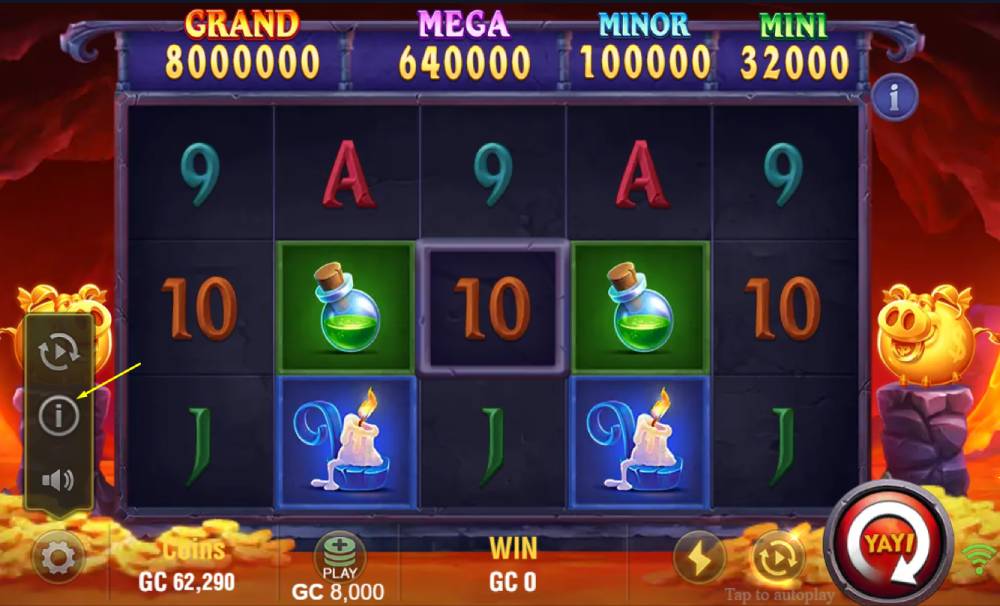
How to Find RTP Information
Both online casino games and operators have their average RTPs. For games, you can find the information in their game details section, usually indicated with a small letter “i” within a circle.
All you have to do is select a game and check its “More Info” section. That way, you know what to expect regarding average returns before playing.
For casinos, you can find the RTP details on their websites or help centers. However, you can manually double-check the RTP information using the formula below.
RTP vs. Volatility: Two Sides of the Same Coin
Understanding RTP meaning requires looking at slot volatility as well. While RTP tells you how much a game pays back over time, slot machine volatility tells you how often and how large those payouts tend to be.
- Low-volatility slots tend to deliver small, frequent wins. These games approach their RTP faster since outcomes are more consistent.
- High-volatility slots offer bigger wins but far less frequently. You might spin 200 times with minimal results before a huge win comes through. In these cases, it might take thousands of spins to approach the game’s RTP.
So, if you’re asking what RTP means in casino play, remember that it’s the theoretical baseline, while volatility is what creates the real-life drama and variety.
Slot Volatility vs. RTP: The “Player Vibe” Matrix
| Volatility | Typical RTP Range | How the Slot “Feels” | Best For… |
|---|---|---|---|
| Low | 96% – 98%+ | You win small amounts almost every other spin. Your balance stays flat. | Clearing playthrough requirements or playing for hours on a small coin budget. |
| Medium | 95% – 97% | Occasional “big wins” (10x-20x) keep you excited, but dry spells exist. | Looking for a mix of entertainment and a chance at a decent prize. |
| High | 94% – 96.5% | You can go 50 spins with zero wins. Then, a 500x “Max Win” hits out of nowhere. | Players with a large bankroll chasing a life-changing jackpot |
| Progressive | 88% – 93% | The base game feels “tight” and unrewarding because a portion of every play fuels the pot. | Players who only care about hitting the multi-million coin jackpot. |
Progressive & “Build-Up” Features: When RTP Is Unlocked Only at the Finish Line
Many modern slots, especially the most engaging social casino games, include progress meters, coin collections, or unlockable bonus rounds. While exciting, these features can delay access to a game’s full RTP potential.
For instance:
- A progressive meter that fills over multiple sessions might only contribute significantly to RTP when completed.
- A build-up bonus round might offer high-value outcomes, but if you leave the game before triggering it, you’ve missed part of what the RTP accounts for.
That’s why a 96% RTP slot might feel like it’s returning less during short or incomplete play windows. You’re not unlocking its full statistical structure.
Common Myths About RTP
Let’s bust a few myths about RTP that often confuse new players:
| Myth | Reality |
|---|---|
| RTP guarantees short-term results.” | RTP is a long-term theoretical average. Your short session could be above or below it. |
| “A high RTP slot can’t go cold. | Even a 98% RTP slot can go through streaks with minimal wins – variance always plays a role. |
| Jackpot games always have low RTP. | While some do, many progressive slots post 96%+ RTP figures, especially when including base game returns. |
Here are some other common myths that players have about RTP in slots and casinos:
High RTP GuaranteeS Bigger Wins
Though a game may have a high RTP value, it doesn’t necessarily mean you’ll win based on that figure. For instance, a 96% RTP doesn’t mean you’ll win 96% of every game you play. This is because RTP represents how much a casino or a game is expected to pay back over a long period.
Games With High RTPs Are Always Better
High-RTP games are generally more favorable than low-RTP options. However, they aren’t always the best. You may win more from low-RTP games with low volatility than high-RTP games with high volatility.
Slot RTP vs Volatility
As important as RTPs are, they aren’t the only determinants of your potential gaming outcomes. A game’s volatility also comes into play when looking at its winning chances.
To clarify, volatility in slots is how frequently and intensely a game pays out virtual bonuses, while RTP indicates the expected long-term percentage of virtual credits returned to players. In highly volatile games, virtual bonuses occur less frequently but offer larger in-game credit multipliers. This means more variation in virtual credit balance.
Low-volatility games provide more frequent but smaller virtual credit wins. So, when thinking of the frequency or size of winnings, volatility is involved.
Volatility and RTP work hand-in-hand to determine the overall outcome when playing slots.
Practical Tips to Use RTP in a Social-Casino Setting
Even if you’re not playing for monetary gains, RTP still contributes to a more pleasurable gaming experience. Here are a few practical tips:
- Start with higher-RTP games if your goal is longer session play with your available Gold Coins.
- Play more games with high RTP to boost your winning chances.
- Check the slot game’s volatility to determine if it suits your bankroll
- Mix volatility levels to balance quick-action fun with bigger-hit potential.
- Use bonus rounds to maximize your opportunities.
- Look out for special features like wild and scatter symbols
- Track your spin outcomes. Many social casinos let you see win/loss ratios for each session, helping you align experience with expected RTP.
- Try playing games with gold coins first before playing with your sweeps coins.
Simple Thought Experiments to Visualize RTP
Understanding what RTP is in casino games can be tricky without visuals. Here are two analogies to help:
The 100-Sided Die
Imagine a 100-sided die where 99 faces return your stake, and 1 face doesn’t. Over time, you’d average 99 returns out of every 100 spins – a 99% RTP. However, in short runs, you could hit that one “no return” face several times.
The Coin-Flip Analogy
Flipping a coin ten times might give you 7 heads and 3 tails. But flip it 10,000 times, and you’ll likely get close to 5,000 each. RTP works the same way – the more spins you log, the closer you get to the theoretical average.
RTP & Responsible Play
One of the most important takeaways: RTP is not a prediction or a promise. It’s a mathematical average, not a guarantee. That’s why it’s vital to:
- Set session limits based on time or available virtual coins.
- Avoid the “due” fallacy. Just because a slot has run cold doesn’t mean it’s about to heat up.
- Play for entertainment, not as a strategy to chase patterns.
Understanding RTP can guide your expectations, but responsible play ensures your sessions stay enjoyable.
Enhance Your Social Casino Gaming Experience
You can use RTPs to make informed decisions when playing slots and other casino games. RTP in slots helps you understand the odds of winning against the house, helping you determine the casino’s fairness.
You can play various online casino games for free at social casinos like Yay Casino. You’ll get free playing coins to check out your favorite high-RTP slots for a more exciting experience.
What does RTP stand for?
RTP stands for Return to Player. It represents the percentage of the total amount returned to players over time.
How is RTP calculated?
RTP is calculated by dividing the total amount returned to players by the total amount played. It is usually expressed in a percentage format.
Does a high RTP guarantee I will win more?
No, RTP is a long-term average and doesn’t guarantee short-term results.
Where can I find the RTP of a game?
RTP information is usually available on the game’s information or help screen. You can also find it on the online casino’s website
Can I calculate my own RTP?
Yes, you can. All you need to do is track your total games and winnings, divide your winnings by games, and multiply by 100 to get your RTP percentage.